


Accessible article version
The complete article is preserved below in readable, selectable text.
Your past is part of your story—not the end of it
Some experiences end, but their impact can linger. A difficult childhood, betrayal, loss, instability, rejection, trauma, or years of feeling unseen can shape the way we respond to life long after the moment has passed.
Sometimes the connection is obvious. Other times, we simply notice that certain situations bring up intense emotions, trust feels difficult, or the same patterns keep showing up even when we desperately want something different.
Healing from the past does not mean forgetting what happened or forcing yourself to “get over it.” It means understanding how your experiences affected you, processing what you have carried, and learning healthier ways to care for yourself in the present.
How the past can show up in the present
Past experiences can influence the way we think, feel, communicate, and respond to situations today. Sometimes these connections are easy to recognize. Other times, we may not realize that an old experience is influencing a current reaction.
Someone who experienced rejection or abandonment may find themselves constantly worrying that people they love will leave. Someone who grew up around conflict may shut down when disagreements happen. Others may become people-pleasers, struggle to set boundaries, overthink conversations, or feel responsible for keeping everyone around them happy.
These responses often developed for a reason. At one point, they may have helped us feel protected, accepted, or prepared for what might happen next. But as our lives change, those same patterns can begin to interfere with relationships, confidence, and emotional well-being.
Why old experiences can still affect us
Our minds and bodies learn from experience. When we go through painful, stressful, or unpredictable situations, we naturally develop ways of coping. Those coping strategies can stay with us even after the situation itself has ended.
That is why certain conversations, relationships, places, or situations can sometimes bring up emotions that feel much bigger than the present moment. Understanding where those reactions come from can help us respond with curiosity instead of immediately judging ourselves.
Sometimes healing begins with simply recognizing: “I learned to respond this way for a reason—but I do not have to respond this way forever.” With time, support, and intentional change, old survival patterns can be replaced with healthier responses that better reflect who we are and the life we want to create.
What healing can look like
Healing does not mean forgetting your past or pretending difficult experiences never happened. It means learning how to understand what you have been through without allowing those experiences to control every part of your present.
Healing can give you space to recognize old patterns, respond to yourself with more compassion, and begin making choices based on the life you want now—not simply on what you had to do to survive before.
Healing is often found in small changes
Sometimes we expect healing to feel like one major breakthrough. In reality, it often happens through smaller changes that build over time. You may notice yourself pausing before reacting, communicating your needs more clearly, setting a boundary without feeling as guilty, or recognizing when an old fear is influencing a current situation.
You may also begin to feel more comfortable trusting your own judgment. Situations that once caused overwhelming anxiety may become easier to manage. Relationships may feel different because you are learning that you can care about others without abandoning your own needs.
Breaking patterns that no longer serve you
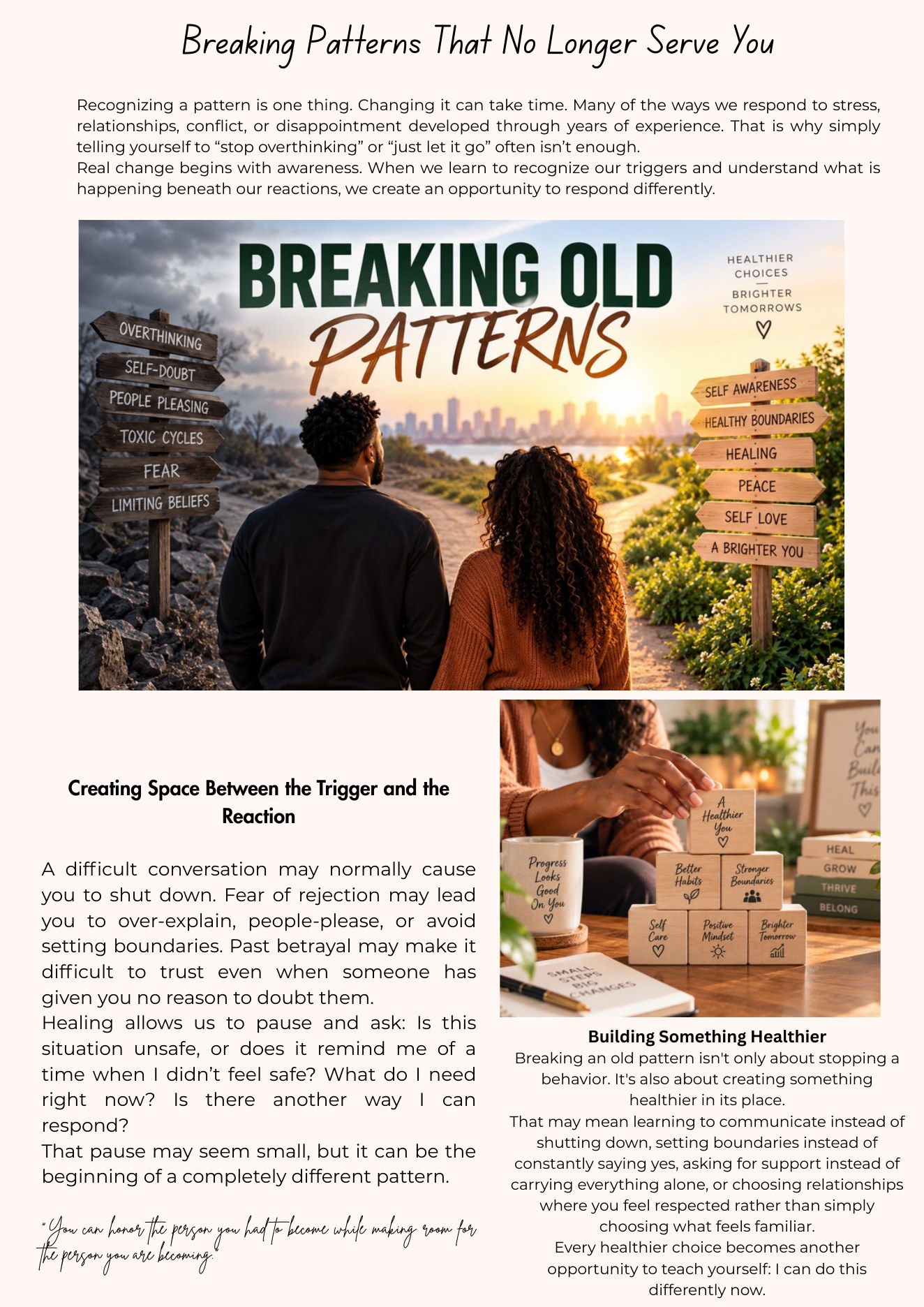
Recognizing a pattern is one thing. Changing it can take time. Many of the ways we respond to stress, relationships, conflict, or disappointment developed through years of experience. That is why simply telling yourself to “stop overthinking” or “just let it go” often is not enough.
Real change begins with awareness. When we learn to recognize our triggers and understand what is happening beneath our reactions, we create an opportunity to respond differently.
Creating space between the trigger and the reaction
A difficult conversation may normally cause you to shut down. Fear of rejection may lead you to over-explain, people-please, or avoid setting boundaries. Past betrayal may make it difficult to trust even when someone has given you no reason to doubt them.
Healing allows us to pause and ask: Is this situation unsafe, or does it remind me of a time when I did not feel safe? What do I need right now? Is there another way I can respond? That pause may seem small, but it can be the beginning of a completely different pattern.
You can honor the person you had to become while making room for the person you are becoming.
Building something healthier
Breaking an old pattern is not only about stopping a behavior. It is also about creating something healthier in its place. That may mean learning to communicate instead of shutting down, setting boundaries instead of constantly saying yes, asking for support instead of carrying everything alone, or choosing relationships where you feel respected rather than simply choosing what feels familiar.
Every healthier choice becomes another opportunity to teach yourself: I can do this differently now.
How therapy can help
You do not have to navigate healing alone. Therapy can provide a supportive, nonjudgmental space to understand how past experiences may still be affecting your emotions, relationships, choices, and sense of self. Therapy is not about changing who you are or telling you how you should feel. It is about helping you better understand yourself, recognize patterns that may no longer serve you, and develop tools that support the life you want to create.
Sometimes we become so accustomed to carrying certain experiences that we do not realize how much they are affecting us. Talking with a therapist can create space to slow down, explore those experiences at your own pace, and begin connecting the dots between the past and present. You do not have to tell your entire story during your first session. Healing can happen gradually, and you get to decide what you are ready to explore.
- Stronger boundaries and healthier coping skills
- Clearer communication and greater self-awareness
- Healthier relationships and emotional regulation
- More self-compassion and a stronger sense of confidence
Learning new ways to move forward
Understanding the past is important, but therapy can also focus on what comes next. Together, you and your therapist can identify practical strategies for handling triggers, communicating your needs, managing difficult emotions, and responding differently when old patterns begin to surface.
No two healing journeys look exactly the same. Therapy gives you space to move at your own pace, explore what matters to you, and build tools that fit your life. You do not have to have everything figured out before asking for support.
Over time, small changes can become new habits—and those new habits can help create healthier relationships, greater emotional freedom, and a future that feels more aligned with who you are today.
Your past does not have to write your future
Healing does not require you to forget what happened or become a completely different person. It can mean understanding yourself more deeply, recognizing what you need, and giving yourself permission to make different choices moving forward.
Some days, progress may feel significant. Other days, it may simply mean recognizing a trigger before reacting, communicating a need, setting one boundary, or choosing to be a little more compassionate with yourself. Those small steps matter.
If experiences from your past are affecting your relationships, emotions, confidence, or ability to move forward, therapy can give you a supportive place to begin. You do not need to have everything figured out, you do not need to know exactly what to say, and you do not have to tell your entire story in the first session. You can simply start where you are.
Ready to ask about your options?
SCCS Texas offers online care for adults. Self-pay is available, and Aetna, Cigna, and BCBS Texas are accepted. Coverage depends on your plan and clinician.
Ask the Texas team